
Case files from the desert Southwest
Desert
Eccentric
True Stories of Outcasts, Visionaries & Madmen
C. V. Wooster
Open the fileAI-generated film · artistic interpretation
Case files from the desert Southwest
True Stories of Outcasts, Visionaries & Madmen
C. V. Wooster
Open the fileAI-generated film · artistic interpretation
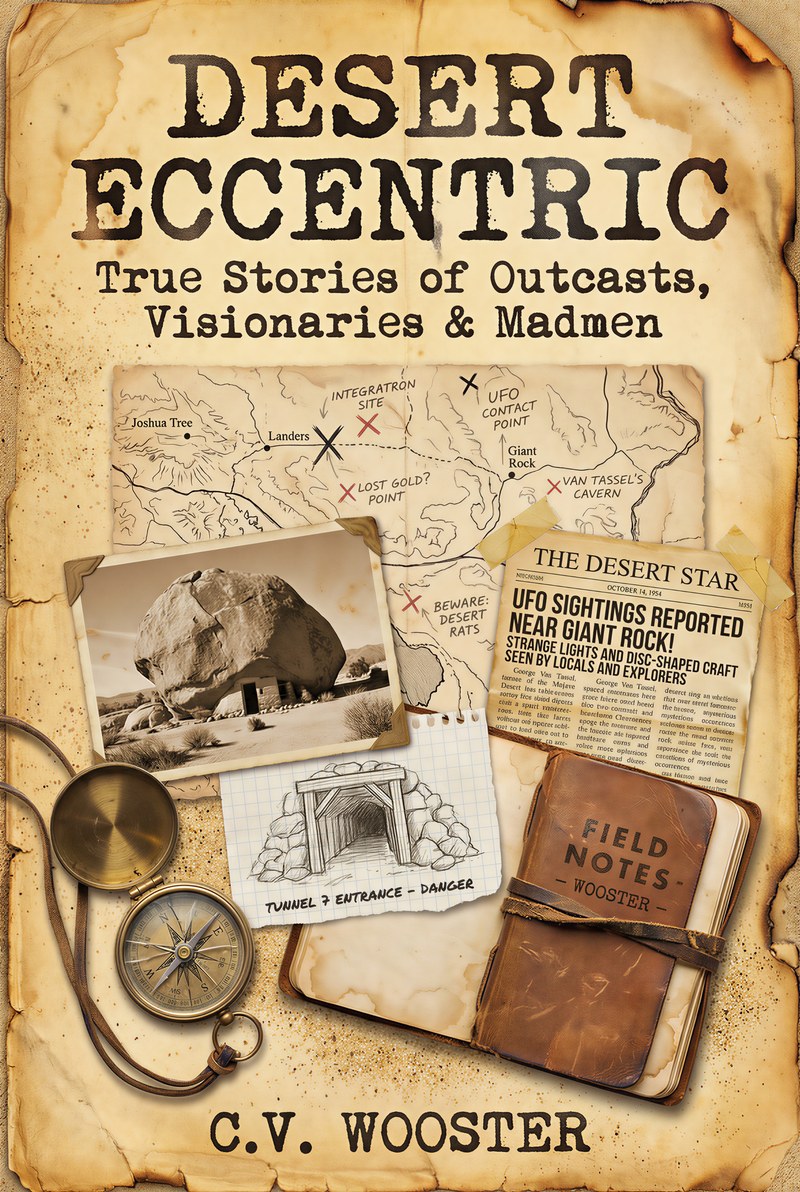
Desert Eccentric gathers twenty-three of their stories, from the Mojave and Death Valley to the Salton Sea and the canyon country of Utah. Frank Critzer made his home in a dugout beneath Giant Rock. George Van Tassel said he was visited by a being from Venus, then spent more than twenty years building the Integratron. Burro Schmidt cut a half-mile tunnel through a mountain over nearly four decades and never hauled an ounce of ore through it.
Pancho Barnes raced airplanes and ran a notorious ranch in the Mojave. Leonard Knight painted salvation across a hillside. Bill Keys built a homestead empire and killed a man for it. Everett Ruess walked into the canyons and was never seen again. Prospectors and painters, hermits and prophets, a millionaire and the con man who charmed him: real people, drawn from their own letters and memoirs, old newspapers and court records.
Coming in ebook, paperback and hardcover.
Frank Critzer, the man who made Giant Rock his home
George Van Tassel, who was supposedly contacted by extraterrestrial life
William “Burro” Schmidt, the man who carved a tunnel to nowhere
Marshal South, the poet who made Ghost Mountain his kingdom
Pancho Barnes, the pilot who brought to life the legendary Mojave ranch
Walter “Death Valley Scotty” Scott, the charlatan of Death Valley, and Albert Johnson, the millionaire who built his castle
Cabot Yerxa, the architect of the Pueblo
Agnes Pelton, the painter who made the desert her cathedral
Frank “Shorty” Harris, who made some of the most significant gold strikes in Death Valley history
Carl Eytel, the German artist who became the desert’s first true witness
William Pester, the German wanderer who became the hermit of Palm Canyon
Leonard Knight, the man who painted salvation on a hillside in the desert
Captain Charles E. Davis, the monarch of Mullet Island
Bill Keys, the homesteader who built an empire and killed a man for it
Everett Ruess, the young artist who walked into the desert and did not come back
Mary Hunter Austin, the writer who heard the desert’s voice and gave it to the world
Thomas “Pegleg” Smith, the trapper who cut off his own leg and left behind a legend of lost gold
Francis Marion “Borax” Smith, the king of the desert mines
Howard Hughes, the reclusive innovator
John Wesley Powell, the river-bound visionary
Edward Abbey, the desert’s unruly prophet
four travelers who entered the desert and never came home
Charles “Charlie” Steen, the prospector who ignited the atomic frontier
From the book
A German prospector made his home beneath a boulder seven stories high. A man called Burro spent nearly four decades driving a tunnel through a mountain. A woman who had raced airplanes ran a dude ranch on the edge of an Air Force base until a long fight with the government ended it. A uranium prospector nobody believed drilled into ground everyone called worthless and found one of the richest deposits in the country.
All of them belonged to the deserts of the American West. Those deserts stretch across time as much as geography, an expanse of sand, scrub, and stone where the desperate and the daring alike have come to wager everything they had. They are desolate yet alive, barren yet full of promise. People have come to them to survive and to start over, and the land has kept a record of both, in tailings, in foundations, in names scratched into rock.
By the mid-20th century, the Mojave was the last long stretch of America’s most famous highway. Route 66 promised a neon-lit path to the Pacific, and the desert was where that promise met the heat in the last hard miles before the sea.
None of it was empty. For the Serrano, the Chemehuevi, the Cahuilla, and the Mohave, this country was the center of everything. They knew its washes, springs, and dry lakes the way a farmer knows a field, and they lived on what it grudgingly gave.
The settlers who came later brought picks, wagons, and the habit of claiming whatever they could reach. For every boomtown that lasted there were others that sank back into the dust nearly as fast as they had gone up. The desert rewarded patience and punished almost everything else.
It took in other kinds, too, people who had not come for gold at all. Painters came, and writers, inventors, preachers, and men and women who wanted to vanish from their pasts or their debts. Some found beauty out there. Some found money. Some found ruin, and a few found all three.
This book is about some of them: a hermit, a contactee, a tunneler, a poet on a mountain, a pilot, a showman, a painter of visions, a uranium man, and others who went into the desert and did not come back the same. Where the record is solid, the book says so. Where it thins into rumor, the book says that too.
Here is told the tale of each of them, one chapter at a time.
From Desert Eccentric · © 2026 C. V. Wooster